
Read Sanilac County Tax Fields
Every Sanilac County tax record pulls from two streams. The assessor or county parcel report covers property characteristics and value fields. Billing and delinquency live elsewhere. Local city and township treasurers collect current bills. The County Treasurer receives unpaid summer and winter taxes after the annual turnover. Keeping those roles straight stops you from reading a current charge as a county delinquency.
| Field | What It Shows | Where |
|---|---|---|
| Assessed value and SEV | Assessment measures reported for the parcel | Local assessor or parcel report |
| Taxable value | The value to which authorized rates apply | Assessment roll and tax bill |
| PRE field | Principal Residence Exemption status or percentage | Parcel card and assessor |
| Current bill | Charges, due date, and payment status | City or township treasurer |
| Delinquent account | Unpaid tax, additions, and later process | Sanilac County Treasurer |
A tax bill is not a sale-price estimate. Michigan records draw hard lines between true cash value, assessed value, state equalized value, capped value, and taxable value, and the billed amount also reflects authorized rates and any exemptions. Compare the same parcel across like years before concluding anything.
Sanilac Assessment Terms Decoded
Michigan's Board of Review guidance defines the core terms. True cash value is the assessor's market-value conclusion. Assessed value generally runs one-half of that figure, subject to equalization. State equalized value reflects the equalized assessment. Taxable value is the number millage actually multiplies, and capped value can hold it down until a transfer triggers uncapping under state rules.
- Assessed value
- The assessor's statutory value measure for the parcel.
- Taxable value
- The value used to calculate tax after applicable limits.
- Millage
- Tax imposed per thousand dollars of taxable value.
- PRE
- The Principal Residence Exemption from the local school operating millage for qualifying property.
- Tax lien
- A claim tied to unpaid property tax.
Never treat a sale price and a taxable value as the same measure. Transfer history, exemptions, equalization, and the tax year can explain a wide gap.
FetchGIS Starts the Tax Search
The Sanilac FetchGIS viewer takes a parcel number, owner name, or street address per the county guide. Search the address and open Show Details. Copy the PIN and the report year. The guide covers current-tax-year parcel information but publishes no complete historical roll range.
| Parcel number | Exact cross-office key; preserve all zeroes and hyphens |
|---|---|
| Owner and mailing | Assessment-roll party and notice address for that record date |
| Situs | Physical property address |
| Classification and PRE | Tax context when displayed |
| Value and sales fields | Dated assessment and transfer clues |
Write down the result date. Sanilac County publishes no verified roll-update lag, so a just-recorded deed can be newer than the owner line on a parcel report.
Current and Delinquent Sanilac Taxes
City and township treasurers send and collect current summer and winter bills in Sanilac County. The split matters here. Local treasurers keep current bills, and the County Treasurer collects delinquencies after turnover from the county's 26 townships, nine villages, and four cities. That split is the key access rule for Sanilac County property tax records.
The Treasurer FAQ places the turnover of unpaid summer and winter taxes on March 1. Need a county-level answer? Call 810-648-2127 with the 14-digit parcel number and request a delinquent-tax printout when needed.
The official Sanilac County Treasurer page lays out the delinquent-tax and tax-sale routes.
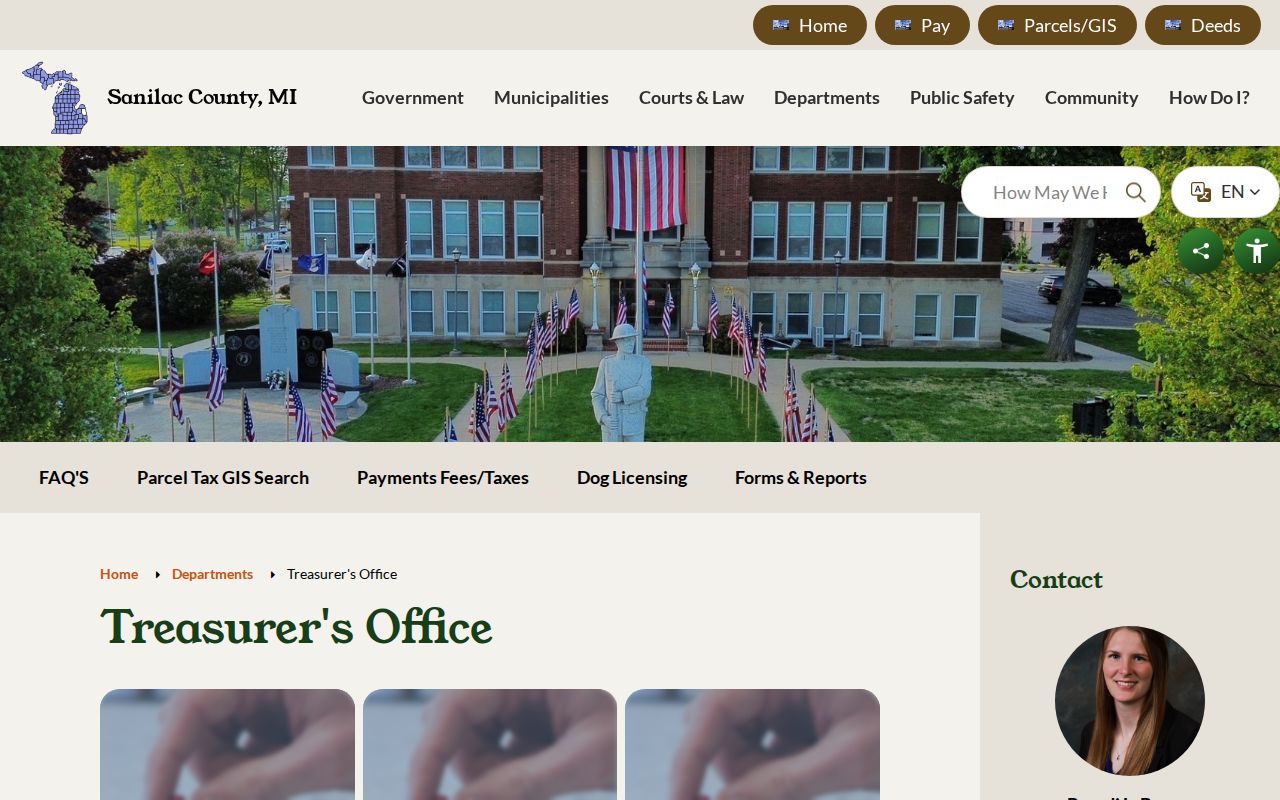
The Treasurer's page points you to the right county channel. A current bill still belongs with the local city or township treasurer.
Note: Failure to receive a bill does not waive the published interest, penalty, or administrative additions on unpaid Sanilac taxes.
Look Up a Sanilac Tax Bill
Start with the parcel, not the owner name alone. The exact PIN stays reliable when ownership or mailing data shifts mid-year. Next, find out whether the bill is still current with the local treasurer or has already moved into county delinquency.
- Search FetchGIS by address and copy the complete PIN.
- Check the parcel report's tax year, value fields, class, and PRE status.
- Contact the city or township treasurer for a current bill and payment status.
- After March 1 turnover, contact the County Treasurer with the 14-digit PIN.
- Record the tax year, balance date, additions, and foreclosure or sale stage separately.
- Tax year
- The year to which the charge applies.
- Payoff date
- The date through which quoted interest and fees are calculated.
- Delinquency
- Unpaid tax transferred to the county process.
- Foreclosure stage
- A dated procedural status, not proof that a sale finished.
Sanilac Due Dates and Additions
September 14 is the due date for village taxes and summer taxes under the Treasurer FAQ. Village bills add a 4 percent administrative fee. They also add 1 percent monthly interest after that date. Summer bills carry the same 1 percent monthly interest afterward. Winter taxes come due February 14. Some units tack on a 3 percent penalty during February 14 through 28.
On March 1, unpaid summer and winter taxes turn over to the county. The county adds its own 4 percent administrative fee and 1 percent monthly interest. Other statutory costs may apply. City rules can differ. Confirm the exact charge with the treasurer collecting for your parcel and date.
Sanilac PRE and Transfer Records
A Principal Residence Exemption percentage can show up on a Sanilac County parcel report. But eligibility flows from Michigan law and filed forms, not an address. The state PRE guidelines spell out qualifying ownership and occupancy. Read any displayed percentage against its tax year. Check with the local assessor if it looks wrong.
Michigan Property Transfer Affidavit Form 2766 records the transfer date, price, PIN, location, and owner information. Its instructions allow a 45-day filing window. A transfer can uncap taxable value under state rules. That is why a buyer's later tax record may not track the prior owner's taxable value.
2026 Sanilac Equalization Context
The county reports page posts 2026 Tentative Ratios and a 2026 Equalization Report next to prior L-4028, rate, and valuation reports. These official, dated files give countywide and unit-level context. They do not replace a parcel card or a local bill.
One local example shows why unit and class matter. Sandusky's 2026 tentative ratios list commercial at 43.29 percent, industrial at 41.18 percent, residential at 50.76 percent, and personal property at 50 percent. Those figures describe class-level reporting context, never the value of one named parcel.
Sanilac Tax-Sale Status
The County Treasurer page is the starting point for Sanilac County land auctions, linking out to tax-sale.info. The Treasurer's office posts sale-stage notices there, but the live sale fields, redemption instructions, and year cutoff are not published as county property records. Any listing should be read as a dated notice. Confirm the current status with the Treasurer before acting.
A delinquent tax bill never proves current ownership. Nor does a sale notice prove a sale finished. For each parcel, note the tax year, payoff date, foreclosure stage, and source, then ask the Register of Deeds whether a later instrument was recorded.
Sanilac Tax Forms Create Records
The Sanilac County Treasurer's forms and reports page covers several tax documents. These feed the property records system. It lists a Summer Tax Deferment form, Tax Certification for property splits, and notices tied to foreclosure-sale proceeds. There is also a PRE Denial Listing dated March 7, 2026. Each belongs to a separate process. A blank form proves nothing about any particular parcel.
A split certification matters most when the parcel number changes. Keep both the old and new PINs, the effective dates, and the legal description. Match any PRE denial to its cited tax year and the local assessor record. A foreclosure-proceeds notice involves a claim process, not ownership of record.
Ask the Treasurer or assessor for the filed document, decision, or parcel-specific printout. A normal office request does not always produce it. Michigan FOIA can reach an existing public record in that case. You supply a clear PIN and date range.
Contest a Sanilac Assessment
A Sanilac County assessment challenge begins locally. The city or township assessor handles appeals. Its Board of Review hears them too. The County Treasurer does not. Gather the assessment notice and parcel report. Add property facts, photos, and comparable sales. Include anything showing a classification or exemption error. Meeting dates, petition forms, and delivery rules vary by unit. Confirm them with that local office directly.
The Michigan Board of Review Q&A lays out true cash value and assessed value. It also covers state equalized value, taxable value, capped value, and post-transfer uncapping. Those definitions help you frame a claim around the exact field you believe is wrong. No single countywide appeal form or deadline governs every Sanilac County unit.
Appeal window. Sanilac County owners must confirm the current local Board of Review calendar and filing method. No single verified countywide deadline was found.
Tax bills and assessments are related but separate tracks in Sanilac County property records. Disputing one does not change the other, and paying either does not resolve an appeal. Keep proof of filing and the board's written decision with the parcel's dated tax records.
Keep Sanilac Tax Evidence Dated
Good evidence has a date on it. Save the PIN, tax year, retrieval date, office name, and balance-through date. Keep any receipt or written decision as well. If the parcel was split or transferred, keep both identifiers and the effective date too. This habit keeps a prior tax bill, a later deed, and a newer appraisal apart. It prevents one false timeline.
Before a payoff, appeal, or purchase, ask the responsible Sanilac County office for a response. Ask that it be fresh and parcel-specific. Countywide reports and online summaries give context. The dated local record controls the question.