
Match Sanilac County Deed Types
Every search of Sanilac County deed records starts with instrument type. The Register of Deeds files documents affecting real property, yet each one does different work. A deed documents a transfer between named parties. It also supplies the legal description needed to follow the land. Mortgages, liens, easements, and releases can affect the same parcel without moving ownership at all.
| Deed Type | What It Does | Common Use |
|---|---|---|
| Warranty deed | Conveys an interest with stated covenants | Recorded sale or transfer |
| Quitclaim deed | Conveys the grantor's interest without warranty | Family, estate, or corrective transfer |
| Land contract | Records contract rights tied to land | Installment purchase arrangement |
| Fiduciary deed | Reflects action by an authorized representative | Estate or court transfer |
| Easement | Creates a limited land-use right | Access or utilities |
The office also records assignments, mortgage discharges, land contracts, rights of way, oil and gas leases, subdivision plats, surveys, land corners, and court orders affecting real property. Match the related references. Only then decide what a filing truly means.
Sanilac Deeds Carry Four Keys
Four keys anchor a reliable match: party names, recording date, recording reference, and legal description. The parcel number helps too, though the LandWeb result fields are not open to view. An official Croswell parcel packet lists sales rows. Each row gives grantor, grantee, price, date, instrument type, terms, liber and page, verification, and transfer percentage. Treat that as parcel-card evidence, not a promise about LandWeb.
- Grantor
- The party conveying an interest.
- Grantee
- The party receiving an interest.
- Chain of title
- The linked sequence of recorded transfers for the same land.
- Liber and page
- A book and page citation for a filing.
- Instrument number
- A sequential identifier used to retrieve a filing.
Names change and repeat in Sanilac County. Trust or company wording varies as well. The legal description is the continuity check that tells one tract from another.
Sanilac LandWeb Has a Gap
The Sanilac LandWeb endpoint returns an HTTP 500 response. The county page states no earliest online year, imaging cutover, result limit, or image-payment gate. Without those details, no online cutoff can be responsibly published.
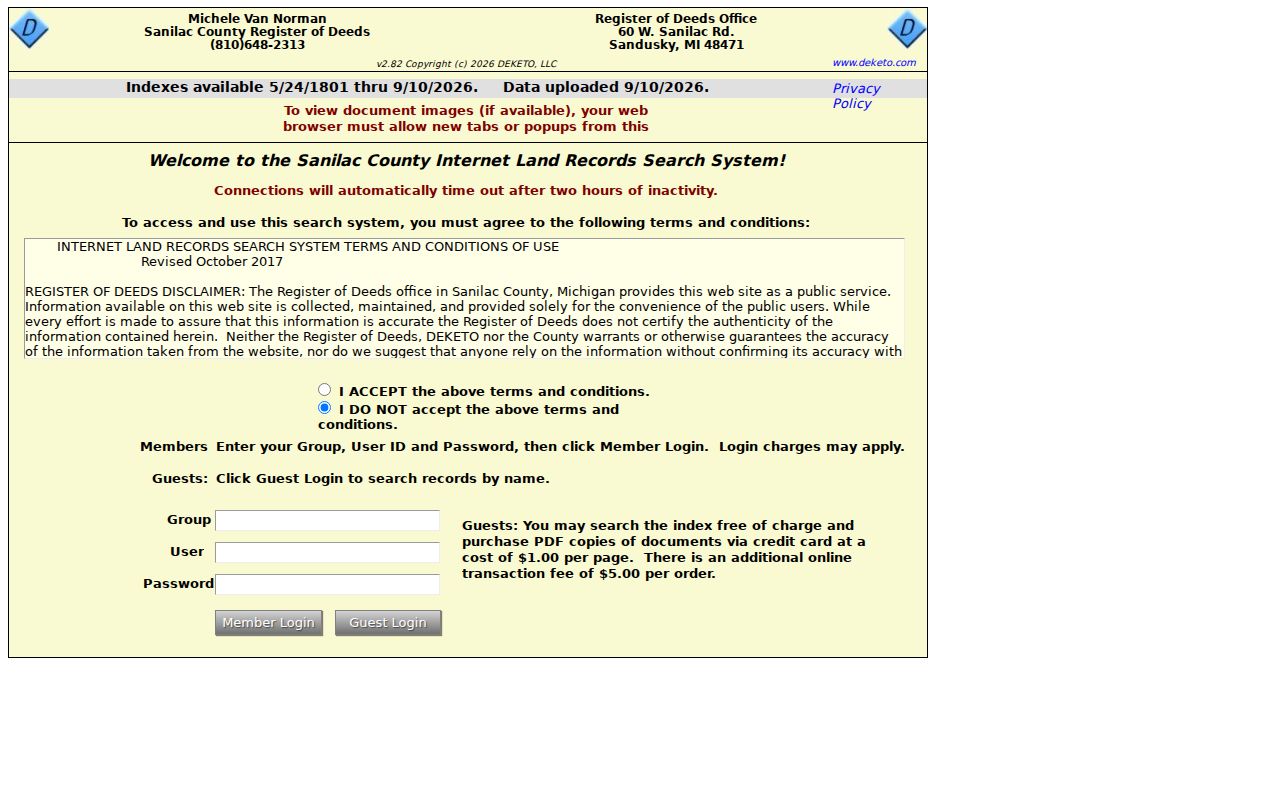
The official portal page shows the access route but not the searchable coverage or the result fields. Those details stay unclear on the page itself.
Use every documented route instead. Retry the portal. Call or visit the Register of Deeds, and ask staff to search or retrieve a known book, page, or instrument. A precise mail inquiry should include party names, an approximate date, and the legal description. Older books may still require office or archive research.
Note: An unavailable web index says nothing about whether the underlying Sanilac County deed record exists at the courthouse.
Recent Sanilac Transfer Lists
The county land-transfer page posts PDF lists dated August 3, 10, 17, and 24, 2026. LandWeb is down. These timely snapshots can supply a party name or a likely recording date. Save the PDF date. Then carry that clue straight to the Register of Deeds.
A weekly list is not the deed image. It is not a full ownership history or a report of every title exception. Its job is narrow. It flags recent activity worth verifying in the official index or office file.
Trace Sanilac's Grantor-Grantee Chain
Grantor and grantee roles form the chain in Sanilac County. Start with the newest known grantee. This is often the owner printed on a dated parcel report. Find that party's plausible acquisition deed, then compare the land description and date. The grantor named there becomes the next prior owner to search as a grantee.
- Copy the current printed owner, PIN, and legal description.
- Find the newest plausible conveyance to that grantee.
- Record both parties, deed type, date, and reference.
- Search the grantor as an earlier grantee and match the same land.
- Repeat until the required date or the available index ends.
- Reverse index
- An index route used to locate a party in the receiving role.
- Legal description
- The lot, block, plat, section, or metes-and-bounds identity of the land.
- Related instrument
- A prior filing cited by a later assignment, discharge, or release.
Estate, court, land-contract, and corrective filings can interrupt a simple deed-to-deed sequence. Quiet-title, partition, foreclosure, or probate clues may need a court-file cross-check, but the recorded conveyance stays central.
Historic Sanilac Deed Sources
The Archives of Michigan county guide lists land and tax-sale groups reaching back to 1850. It also notes nineteenth-century tax, probate, and court material. These are repository descriptions, not a promise that every volume survives complete. They are a defensible fallback when digital access stops.
Plat language can solve an old-name problem. Hubbard & King's Subdivision of Sanilac Centre is cited at Liber 1, page 31. Sanilac Centre is now Sandusky. Search only the current city name and you may miss that older legal identity. State copies of subdivision plats are available through Accela OLSR. The original recorded plats remain with the Sanilac County Register of Deeds.
Sanilac Recording and Copy Fees
The Register of Deeds fee schedule lists a $30 recording charge regardless of page count under MCL 600.2567(1)(a). Assignments or discharges covering more than one instrument add $3 per added instrument. Certain deeds, contracts, and assignments also require a Treasurer tax certificate, listed at $5.
| Real-estate copy | $1 |
|---|---|
| Certification | $5 per document |
| Plat copy | $3 |
| Atlas copy | $2 |
| Recording | $30 under the stated rule |
Accepted payments include cash, check, money order, in-person card payment with picture ID, and online payment. Confirm the amount, payable-to wording, and delivery method before mailing.
Sanilac Recording Requirements
The county recording rules, citing MCL 565.201, require printed or stamped signer names beneath signatures, dark blue or black ink, a notary name near the signature, and the grantee's street or post-office address. The page also specifies white paper, minimum type size, and margins.
These rules govern a document submitted for recording in Sanilac County. They say nothing about whether the conveyance was legally effective or whether the legal description covers the expected land. The Register of Deeds does not prepare documents or answer legal questions. Drafting and interpretation belong with qualified counsel.
Cross-Check Sanilac Court Deeds
A recorded deed sometimes raises more questions than it answers. A fiduciary deed traces back to a probate order. A sheriff's deed or tax conveyance traces back to a foreclosure. A quiet-title judgment reshapes the chain itself. Pull the recorded instrument first, then carry its parties, dates, and case number into the court file that authorized it.
Two Sanilac courts hold the underlying material. The 76th Probate Court keeps estate and trust files. The 24th Circuit Court keeps civil matters such as quiet title, partition, foreclosure, and lien enforcement. MiCOURT may display a public summary, though wills and similar sensitive records stay off the screen. Ask the court of record for the actual file, copy terms, and any archived location.
Keep the two roles straight. A court order grants authority or settles a dispute. The recorded deed or order creates the land-record entry. A docket name match alone proves nothing without the same parcel or legal description tying the case to the property in Sanilac County.
Free Sanilac Fraud Alerts
Sanilac County offers a free Property Fraud Alert service. Enroll a name with the office. It can then notify you when a document is recorded under it. That early prompt gives an owner of record a chance to inspect the filing quickly.
The alert is only a signal, though. It does not block recording, prove fraud, or substitute for title review. It still serves one practical purpose. An unsolicited mailer may offer expensive deed copies. Compare that price with the county's published copy schedule before paying anything.
Note: Monitor initials, trust wording, and entity-name variants that may affect how a new Sanilac County instrument is indexed.
Obtain a Sanilac County Deed
The Sanilac County Register of Deeds sits at 60 West Sanilac, PO Box 168, Sandusky, Michigan 48471. Counter hours run weekdays from 8:00 a.m. to 4:30 p.m., closing at noon for lunch until 1:00 p.m. The phone is 810-648-2313. Call before you travel or mail anything, since portal access and copy handling can shift.
Have your details ready. Give the office the grantor and grantee names, an approximate date, the legal description, and a book/page or instrument number if you have one. Then request either a plain research copy or a certified copy, depending on what the deed records are needed for.
Recorded, not guaranteed. Sanilac County deed records show filed instruments, not a title opinion. Unrecorded interests and unresolved defects may exist.
Counter visits, phone questions, mail requests, the portal, archived holdings, and plat-copy options each have their place. Pick whichever channel matches the deed's date and the reference you already hold.
Sanilac Legal Descriptions Persist
Street names change. Mailing addresses change too. The recorded legal description can outlast them both. It can still point to the same Sanilac County land. City deeds commonly cite a named plat with lot and block. Rural instruments lean on section, township, range, government lots, acreage, or metes and bounds. Copy the wording exactly, even when it includes an old place name.
Before extending a chain, compare the description on each transfer. A shared surname, grantor, or mailing address cannot fix a tract mismatch. Where wording shifts after a split, combination, or new plat, find the instrument explaining the transition. Note both parcel numbers on your citation sheet.
Build a citation sheet for every link. Note the exact party spellings, capacities, deed types, recording dates, legal descriptions, and liber/page or instrument numbers. A complete sheet reveals any missing transfer and makes a deed records request far easier for the office to answer.